The Private Choice Test: Character Shows Up Before Anyone Can Applaud
Most people don’t deliberately set out to build a reputation.
But we become aware very early that other people are watching us.
We notice when someone praises us for being helpful. We notice when a teacher approves of our honesty. We notice when a supervisor recognizes extra effort. We notice when our family appreciates something thoughtful we’ve done.
That approval isn’t wrong. Recognition can encourage good behavior.
The problem begins when being seen becomes part of the reason we do the right thing.
That’s where character and reputation quietly separate.
Reputation is largely concerned with what other people believe about you. Character is concerned with what is actually true about you.
Those two can overlap. A person of strong character may eventually develop a good reputation. But they aren’t the same thing, and they aren’t built in exactly the same way.
One of the simplest ways to see the difference is to ask yourself a question:
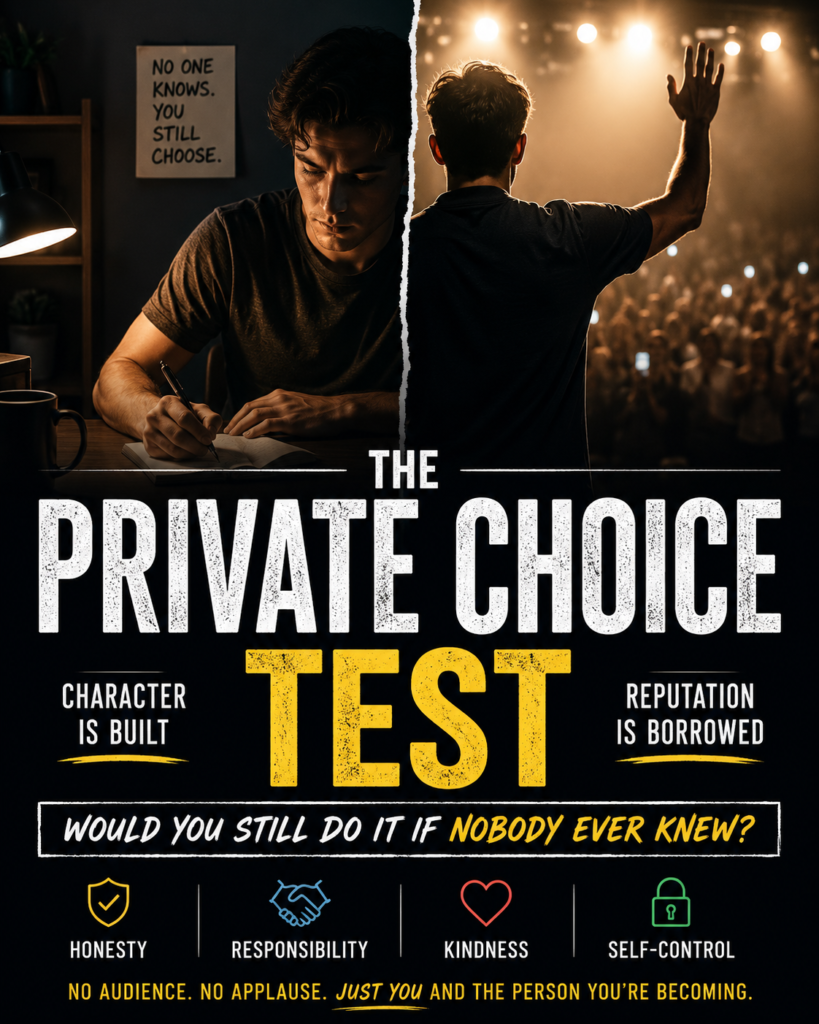
Would I still do this if nobody ever knew?
That’s the Private Choice Test.
It removes applause, recognition, embarrassment, punishment, and social pressure from the decision. What’s left is a clearer look at why you’re doing what you’re doing.
And that can tell you more about your character than many of the choices you make in public.
Remove the audience and see what remains
Imagine two employees who both stay late to finish an important assignment.
From the outside, their behavior looks identical.
One knows the supervisor is still in the building and will probably notice who stays late.
The other knows the supervisor left an hour ago. No one will know whether the project was completed tonight or first thing tomorrow morning. Yet this employee remembers promising that the work would be finished before leaving and decides to keep that commitment.
Both people may have done something useful.
But the second situation tells us something the first one can’t fully reveal.
When the possibility of recognition disappears, the decision becomes less about reputation and more about character.
This is why private choices are so revealing.
Public situations contain outside incentives. You may want approval. You may fear criticism. You may want to look dependable, generous, patient, or honest.
Private situations strip many of those incentives away.
Nobody congratulates you for putting something back where it belongs when no one saw you take it.
Nobody praises you for correcting a small mistake that would probably never be discovered.
Nobody knows you resisted the temptation to say something cruel about another person.
Nobody applauds when you do the job thoroughly instead of doing only enough to get by.
Those moments don’t produce much reputation.
But they produce something more fundamental.
They train character.
A useful way to think about it is this:
Reputation asks, “What will people think of me?” Character asks, “What is the right thing to do?”
That distinction becomes especially valuable when nobody is watching.
Suppose you find a $20 bill on the floor near the checkout counter in a store.
Several possibilities immediately appear.
You could quietly put it in your pocket. Nobody saw you find it.
You could hand it to the cashier because someone may return looking for it.
You could hesitate and start constructing arguments in your mind about why keeping it would be acceptable.
Notice what makes the situation revealing.
There may be no external penalty for making the selfish choice.
The decision isn’t being shaped by a threat to your reputation.
That’s exactly why it becomes a character decision.
The Private Choice Test doesn’t tell you that every moral decision is simple. Some situations genuinely require judgment. But it gives you a useful way to separate two questions that are often tangled together:
Am I doing this because it’s right, or because I want to be seen doing what is right?
Sometimes the answer will be both. That’s normal.
The goal isn’t to become suspicious of every good action you perform in public. The goal is to recognize that character becomes strongest when the behavior survives the removal of the audience.
The unseen repetition is what matters
Character isn’t usually formed in a single dramatic moment.
It’s formed through repetition.
That matters because private decisions are often small enough to seem insignificant.
You might think it doesn’t matter whether you exaggerate one detail in a story when nobody can check it.
It doesn’t seem important whether you leave a shopping cart where it inconveniences someone else when nobody knows it was yours.
You may think it makes little difference whether you complete an unnoticed task carefully or take a shortcut.
But the immediate consequence isn’t the only consequence.
Every repeated choice makes a particular kind of response easier to choose again.
That is one reason the Private Choice Test is practical rather than merely philosophical.
It lets you look beyond the isolated action and ask a second question:
What kind of response am I practicing?
Consider honesty.
Most people think of honesty in terms of major lies. But character is often trained through much smaller opportunities.
Suppose you make a mistake on a work project.
It causes no serious damage. Nobody has noticed. You could correct it quietly and move on without mentioning that you made the error.
Perhaps that’s appropriate if the mistake is genuinely inconsequential.
But suppose the error affects information another person will rely on. Correcting the work without explaining what happened leaves that person with a false impression about the reliability of the original information.
Now the private choice matters.
You can protect your image or protect the truth.
That is the deeper conflict.
A reputation-focused question might be:
“What will they think of me if I admit I made this mistake?”
A character-focused question is:
“What does honesty require here?”
The second question simplifies the decision because it changes what you’re optimizing for.
You’re no longer trying to control another person’s opinion.
You’re trying to make your action consistent with the quality you want to possess.
The same pattern applies to responsibility.
Suppose you’ve promised to take care of something for another person. Circumstances change. Keeping the promise becomes inconvenient.
No one is forcing you to follow through.
You could probably offer an excuse and no one would challenge it.
The Private Choice Test asks:
If nobody would blame me for backing out, would I still believe I should keep my word?
That question separates obligation from pressure.
Kindness works the same way.
It’s easy to behave kindly toward someone who can reward us, recommend us, praise us, or return the favor.
But consider the person who has nothing to offer you.
The restaurant employee who is overwhelmed.
The elderly shopper moving slowly in front of you.
The customer-service representative who didn’t cause the problem you’re calling about.
The person whose name you don’t know and may never see again.
When kindness offers no social advantage, it becomes much easier to see whether kindness is part of your character or simply part of your strategy.
Self-control may reveal even more.
Public self-control often comes with consequences.
You don’t shout at someone in a meeting because others would see it.
You don’t insult the customer because you might lose your job.
You don’t lose your temper in church because the social cost would be immediate.
But what happens at home?
What happens online when you can hide behind a screen?
What happens inside your own thoughts when you feel justified in anger?
The absence of applause isn’t the only test of character.
Sometimes the absence of consequences is the stronger test.
That leads to another useful version of the Private Choice Test:
Would I make the same choice if there were no reward for doing right and no penalty for doing wrong?
That question can expose motivations that ordinary self-evaluation misses.
It also explains why reputation can occasionally deceive us.
A person may appear disciplined because consequences keep them disciplined.
A person may appear generous because generosity brings recognition.
A person may appear honest because dishonesty would be discovered.
Again, this doesn’t mean their good behavior is false.
It means we don’t yet know what the behavior rests on.
Character becomes clearer when the external supports are removed.
Think about a business owner who discovers that a customer was accidentally charged twice.
The customer hasn’t noticed.
The bookkeeping system won’t automatically flag the problem.
The amount is small enough that the owner could probably say nothing and never hear about it again.
There are two possible measures of success.
One is financial: the business keeps the extra money.
The other is character: the owner contacts the customer, explains the mistake, and issues the refund.
The important part isn’t that the owner might later receive praise for honesty.
The important part is that the owner makes the decision before knowing whether anyone will praise it.
That is why the order matters.
Character makes the choice first. Reputation may arrive later.
That’s a repeatable distinction worth remembering.
If you reverse the order and make recognition necessary before you’ll choose correctly, you’re no longer letting character lead.
You are letting the audience lead.
The practical value of this idea appears in everyday decisions.
When you face a choice involving honesty, responsibility, kindness, or self-control, mentally remove four things:
Recognition.
Reward.
Punishment.
Observation.
Then ask:
What would I choose if none of those existed?
You don’t have to analyze every minor decision this way. Use the test when you notice yourself hesitating because you’re thinking about how the decision will look.
Use it when you’re tempted to cut a corner because nobody will know.
Use it when you’re considering doing something impressive mainly because people will notice.
Use it when you feel justified in behaving differently in private than you would in public.
The test isn’t intended to make you feel guilty about imperfect motives. Human motives are often mixed.
Instead, it gives you a direction.
Suppose you do something generous and part of you enjoys receiving appreciation. There’s nothing necessarily wrong with enjoying appreciation.
The better question is:
Would the generosity disappear if the appreciation disappeared?
If the answer is yes, you’ve learned something useful about where growth may be needed.
If the answer is no, you’ve learned something useful too.
The same applies when no one knows you’ve passed the test.
That’s actually the point.
Character development doesn’t require witnesses.
Some of the most important victories in a person’s life may be decisions nobody else ever hears about.
You told the truth when lying would have been easier.
You returned something nobody knew you had.
You kept a promise after everyone forgot you made it.
You refused to join in gossip.
You finished the task properly even though nobody would inspect it.
You treated someone with dignity when that person could do nothing for you.
Those choices may never improve your reputation because no one knows they happened.
But they improve something more important.
They make the next right choice a little more natural.
And over time, the interesting thing is that private character often stops staying completely private. Patterns eventually become visible. People may not know the individual choices that created the pattern, but they experience the result.
They learn that your word means something.
They discover you can be trusted with responsibility.
They notice that your kindness isn’t selective.
They find that your behavior doesn’t change dramatically depending on who is in the room.
That is when reputation becomes something healthier.
It stops being an image you’re trying to manufacture and becomes a reflection of character other people have gradually discovered.
So when you find yourself facing a choice and wondering how it will look, change the question.
Don’t begin with, “What will people think?”
Don’t even begin with, “Will anyone find out?”
Ask:
Would I still do this if nobody ever knew?
Then pay close attention to the answer.
Because the choices that receive no applause may be the choices that tell you most clearly who you’re becoming.
Most people don’t deliberately set out to build a reputation.
But we become aware very early that other people are watching us.
We notice when someone praises us for being helpful. We notice when a teacher approves of our honesty. We notice when a supervisor recognizes extra effort. We notice when our family appreciates something thoughtful we’ve done.
That approval isn’t wrong. Recognition can encourage good behavior.
The problem begins when being seen becomes part of the reason we do the right thing.
That’s where character and reputation quietly separate.
Reputation is largely concerned with what other people believe about you. Character is concerned with what is actually true about you.
Those two can overlap. A person of strong character may eventually develop a good reputation. But they aren’t the same thing, and they aren’t built in exactly the same way.
One of the simplest ways to see the difference is to ask yourself a question:
Would I still do this if nobody ever knew?
That’s the Private Choice Test.
It removes applause, recognition, embarrassment, punishment, and social pressure from the decision. What’s left is a clearer look at why you’re doing what you’re doing.
And that can tell you more about your character than many of the choices you make in public.
Remove the audience and see what remains
Imagine two employees who both stay late to finish an important assignment.
From the outside, their behavior looks identical.
One knows the supervisor is still in the building and will probably notice who stays late.
The other knows the supervisor left an hour ago. No one will know whether the project was completed tonight or first thing tomorrow morning. Yet this employee remembers promising that the work would be finished before leaving and decides to keep that commitment.
Both people may have done something useful.
But the second situation tells us something the first one can’t fully reveal.
When the possibility of recognition disappears, the decision becomes less about reputation and more about character.
This is why private choices are so revealing.
Public situations contain outside incentives. You may want approval. You may fear criticism. You may want to look dependable, generous, patient, or honest.
Private situations strip many of those incentives away.
Nobody congratulates you for putting something back where it belongs when no one saw you take it.
Nobody praises you for correcting a small mistake that would probably never be discovered.
Nobody knows you resisted the temptation to say something cruel about another person.
Nobody applauds when you do the job thoroughly instead of doing only enough to get by.
Those moments don’t produce much reputation.
But they produce something more fundamental.
They train character.
A useful way to think about it is this:
Reputation asks, “What will people think of me?” Character asks, “What is the right thing to do?”
That distinction becomes especially valuable when nobody is watching.
Suppose you find a $20 bill on the floor near the checkout counter in a store.
Several possibilities immediately appear.
You could quietly put it in your pocket. Nobody saw you find it.
You could hand it to the cashier because someone may return looking for it.
You could hesitate and start constructing arguments in your mind about why keeping it would be acceptable.
Notice what makes the situation revealing.
There may be no external penalty for making the selfish choice.
The decision isn’t being shaped by a threat to your reputation.
That’s exactly why it becomes a character decision.
The Private Choice Test doesn’t tell you that every moral decision is simple. Some situations genuinely require judgment. But it gives you a useful way to separate two questions that are often tangled together:
Am I doing this because it’s right, or because I want to be seen doing what is right?
Sometimes the answer will be both. That’s normal.
The goal isn’t to become suspicious of every good action you perform in public. The goal is to recognize that character becomes strongest when the behavior survives the removal of the audience.
The unseen repetition is what matters
Character isn’t usually formed in a single dramatic moment.
It’s formed through repetition.
That matters because private decisions are often small enough to seem insignificant.
You might think it doesn’t matter whether you exaggerate one detail in a story when nobody can check it.
It doesn’t seem important whether you leave a shopping cart where it inconveniences someone else when nobody knows it was yours.
You may think it makes little difference whether you complete an unnoticed task carefully or take a shortcut.
But the immediate consequence isn’t the only consequence.
Every repeated choice makes a particular kind of response easier to choose again.
That is one reason the Private Choice Test is practical rather than merely philosophical.
It lets you look beyond the isolated action and ask a second question:
What kind of response am I practicing?
Consider honesty.
Most people think of honesty in terms of major lies. But character is often trained through much smaller opportunities.
Suppose you make a mistake on a work project.
It causes no serious damage. Nobody has noticed. You could correct it quietly and move on without mentioning that you made the error.
Perhaps that’s appropriate if the mistake is genuinely inconsequential.
But suppose the error affects information another person will rely on. Correcting the work without explaining what happened leaves that person with a false impression about the reliability of the original information.
Now the private choice matters.
You can protect your image or protect the truth.
That is the deeper conflict.
A reputation-focused question might be:
“What will they think of me if I admit I made this mistake?”
A character-focused question is:
“What does honesty require here?”
The second question simplifies the decision because it changes what you’re optimizing for.
You’re no longer trying to control another person’s opinion.
You’re trying to make your action consistent with the quality you want to possess.
The same pattern applies to responsibility.
Suppose you’ve promised to take care of something for another person. Circumstances change. Keeping the promise becomes inconvenient.
No one is forcing you to follow through.
You could probably offer an excuse and no one would challenge it.
The Private Choice Test asks:
If nobody would blame me for backing out, would I still believe I should keep my word?
That question separates obligation from pressure.
Kindness works the same way.
It’s easy to behave kindly toward someone who can reward us, recommend us, praise us, or return the favor.
But consider the person who has nothing to offer you.
The restaurant employee who is overwhelmed.
The elderly shopper moving slowly in front of you.
The customer-service representative who didn’t cause the problem you’re calling about.
The person whose name you don’t know and may never see again.
When kindness offers no social advantage, it becomes much easier to see whether kindness is part of your character or simply part of your strategy.
Self-control may reveal even more.
Public self-control often comes with consequences.
You don’t shout at someone in a meeting because others would see it.
You don’t insult the customer because you might lose your job.
You don’t lose your temper in church because the social cost would be immediate.
But what happens at home?
What happens online when you can hide behind a screen?
What happens inside your own thoughts when you feel justified in anger?
The absence of applause isn’t the only test of character.
Sometimes the absence of consequences is the stronger test.
That leads to another useful version of the Private Choice Test:
Would I make the same choice if there were no reward for doing right and no penalty for doing wrong?
That question can expose motivations that ordinary self-evaluation misses.
It also explains why reputation can occasionally deceive us.
A person may appear disciplined because consequences keep them disciplined.
A person may appear generous because generosity brings recognition.
A person may appear honest because dishonesty would be discovered.
Again, this doesn’t mean their good behavior is false.
It means we don’t yet know what the behavior rests on.
Character becomes clearer when the external supports are removed.
Think about a business owner who discovers that a customer was accidentally charged twice.
The customer hasn’t noticed.
The bookkeeping system won’t automatically flag the problem.
The amount is small enough that the owner could probably say nothing and never hear about it again.
There are two possible measures of success.
One is financial: the business keeps the extra money.
The other is character: the owner contacts the customer, explains the mistake, and issues the refund.
The important part isn’t that the owner might later receive praise for honesty.
The important part is that the owner makes the decision before knowing whether anyone will praise it.
That is why the order matters.
Character makes the choice first. Reputation may arrive later.
That’s a repeatable distinction worth remembering.
If you reverse the order and make recognition necessary before you’ll choose correctly, you’re no longer letting character lead.
You are letting the audience lead.
The practical value of this idea appears in everyday decisions.
When you face a choice involving honesty, responsibility, kindness, or self-control, mentally remove four things:
Recognition.
Reward.
Punishment.
Observation.
Then ask:
What would I choose if none of those existed?
You don’t have to analyze every minor decision this way. Use the test when you notice yourself hesitating because you’re thinking about how the decision will look.
Use it when you’re tempted to cut a corner because nobody will know.
Use it when you’re considering doing something impressive mainly because people will notice.
Use it when you feel justified in behaving differently in private than you would in public.
The test isn’t intended to make you feel guilty about imperfect motives. Human motives are often mixed.
Instead, it gives you a direction.
Suppose you do something generous and part of you enjoys receiving appreciation. There’s nothing necessarily wrong with enjoying appreciation.
The better question is:
Would the generosity disappear if the appreciation disappeared?
If the answer is yes, you’ve learned something useful about where growth may be needed.
If the answer is no, you’ve learned something useful too.
The same applies when no one knows you’ve passed the test.
That’s actually the point.
Character development doesn’t require witnesses.
Some of the most important victories in a person’s life may be decisions nobody else ever hears about.
You told the truth when lying would have been easier.
You returned something nobody knew you had.
You kept a promise after everyone forgot you made it.
You refused to join in gossip.
You finished the task properly even though nobody would inspect it.
You treated someone with dignity when that person could do nothing for you.
Those choices may never improve your reputation because no one knows they happened.
But they improve something more important.
They make the next right choice a little more natural.
And over time, the interesting thing is that private character often stops staying completely private. Patterns eventually become visible. People may not know the individual choices that created the pattern, but they experience the result.
They learn that your word means something.
They discover you can be trusted with responsibility.
They notice that your kindness isn’t selective.
They find that your behavior doesn’t change dramatically depending on who is in the room.
That is when reputation becomes something healthier.
It stops being an image you’re trying to manufacture and becomes a reflection of character other people have gradually discovered.
So when you find yourself facing a choice and wondering how it will look, change the question.
Don’t begin with, “What will people think?”
Don’t even begin with, “Will anyone find out?”
Ask:
Would I still do this if nobody ever knew?
Then pay close attention to the answer.
Because the choices that receive no applause may be the choices that tell you most clearly who you’re becoming.
Try This With AI
Use the AI you’re already using: ChatGPT, Claude, Gemini, Grok, Meta AI, Copilot, or another general-purpose AI assistant. Replace the example information inside the brackets with your own information, then copy and paste the complete prompt into your AI.
AI Prompt
Help me apply the Private Choice Test to this situation: [Describe one real decision, temptation, conflict, or situation where you’re unsure whether you’re acting from character or concern about what others will think. Example: “I promised a friend I would help with a project this weekend, but something more enjoyable came up. My friend would probably understand if I canceled, and nobody else would know I backed out.”] Analyze the situation without judging or lecturing me. First, identify the main character quality being tested, such as honesty, responsibility, kindness, self-control, dependability, or another quality that fits better. Then separate the outside pressures from the character issue by identifying any recognition, reward, punishment, embarrassment, approval, or social pressure that could be influencing my choice. Apply these two questions: “Would I still do this if nobody ever knew?” and “Would I make the same choice if there were no reward for doing right and no penalty for doing wrong?” Explain what my answers would reveal about the difference between protecting my reputation and strengthening my character. Point out any mixed motives or reasonable tradeoffs rather than pretending the situation is simpler than it is. Then give me the clearest character-focused decision rule for this specific situation, explain what kind of response each available choice would train me to repeat in the future, and recommend one practical next action that best aligns my behavior with the person I want to become. If you must infer anything about my motives or circumstances, clearly label it as an inference.